Showing posts with label words. Show all posts

Friday, 11 December 2020

Wait for the Stars

The dark has fallen, 

But wait for the stars.

The darkness may be deepening, 

But wait for the stars.

Even if the clouds pour rain upon you,

They must soon pass, so wait,

Wait for the stars.


I know you fear the darkness you have already seen,

But this is not an endless nightmare.

Wait for the stars.

You are haunted by the dark of broken dreams,

But this is only the nighttime, 

Wait for the stars.


No matter how dark it is,

Or how dark it was,

There is always hope, 

Even if it is very small and very far away.

Even if it is only one faint star in the whole of the sky.


Do not let the darkness overwhelm you,

One star will always bring more.

Just wait.

Please wait.

Wait for the stars.


----------------------------------------------------------------------------------------------

Rest Gently Shadow my boy.  One day I will see you again in the stars.  Til then I will wait for grief to pass slowly like the nighttime.  I will trust in the stars even when I cannot see them.  Soon, soon one will shine and the light will increase and slowly the grief will fade.  

Friday, 5 June 2020

Hope Writer Challenge - Restore

Today's prompt for the @hopewriters writing challenge is Restore. #hopewriterlife


I cannot tell you how words and stories may restore other people. I can only speak to my experience. I can only tell you what words do for me.

Sometimes the world is too much and the messages of doubt and fear and inadequacy overwhelm me. They begin to reinforce those intensely negative thoughts my inner critic tells me when I'm not paying too much attention. This inter critic is insidious, it won't engage when I answer back with logic because it knows it has nothing to say.

But it whispers dark fears in my ear when I am not on my guard. And sometimes it's blows land and I'm left reeling, wondering if it's right. That is the moment words are the most critical. I have to find the right ones to join my cause. Recruit the write poetry and friends to stand with me as I prepare for battle.
And for me, I must always do battle on paper. I must write.

You see, the critic thrives on emotion and in the dark corners of your mind where logic can't illuminate it and it can loom shadowy and unopposed. If I drag that inter critic into the light and put it on paper it doesn't stand a chance. The arguments don't hold up. Spoken in dark whispers, "you are worthless" or "you're unnecessary" can be weighty and can coil around you and feel inescapable. Such sentiments prey upon your emotions.
When you put those critiques on paper and engage with the ideas, it takes a little of the weight and sting out of them. So for every dark emotional thought that I'm worthless, that I'll never be a writer and my work is rubbish, that I'm a terrible person (the worst in fact); I make the effort to find at least one argument against them. I do help people and many people rely on me for support. I am capable of many things. And even if I wasn't, every human has worth. I may not be published yet, but I'm not quitting. I am a writer and no writer is perfect, that's what drafts and editing are for. I'm not a terrible person. I'm certainly not the worst ever. Historical examples of worse people abound. And I do what I can. I'm only human but I'm not a bad one. I'm kind of a decent person actually.

Just like that the tide of emotional darkness turns. In the battle for my mind, I drag my opponents into the light and expose their poison and trickery. I defeat them with carefully planned logic and words. Healthier words, truer words, more positive words.

Half the battle is knowing that you're in it and the other half is perseverance. You do not restore yourself in an instant with a flick of your wrist like magic. Restoration is a process, a journey, a series of determined actions.

For me it is important to change the story whenever I feel overwhelmed and belittled. If I feel obligated to attend a party that will be challenging for me because certain attendees make me feel small; I change the story. I look at myself and say "you have a choice. You are choosing to attend this party because you are larger than fear. You are the Queen and you have magnanimously decided to allow your enemies to attend. Pay them no attention." I might still be anxious, but making a conscious choice to turn the story around makes me feel less trapped by circumstances. I feel less small.

Remember that your life is greatly shaped and altered by the story you craft for yourself. Do not let it be created entirely by the critic who's views are false. Make sure you combat it with truth and hope. If you struggle to find the right words, augment your story with poetry that touches your soul. You can borrow someone else's words to help lift your wings.

You are the hero of your own story. No, you cannot change what has come before but you always have a chance to decide what happens next. You can pick yourself up and go about the important process of restoring yourself, put yourself back together with hope, words and perseverance.
So find good words. 

Find great words. 

Write your own words and don't ever accept defeat. 

Imagine a better future and fight for it.

Wednesday, 3 June 2020

Hope Writer Challenge - Reach

An enormous Italian Renaissance style sunset over my house for the #hopewriterlife, writing challenge for @hopewriters about Reach.

Reimagine 2020 with an Idea of Writing Reach and Change


Italian Renaissance Style Sunset in San Diego - photo by Madder Hatter
Italian Renaissance Style Sunset over San Diego


The moment I begin to reimagine this year I start by imagining it without cornonavirus.  My very next thoughts are of comparison, reflecting on the deep differences we see between now and the years we've known of late.  So, for me to reimagine this year with the themes of writing and reach in mind I must compare my present with the recent past.

Writing for me has always been something I must do on occasion when I can't sleep.  My mind runs mad with stories or turns of phrase that demand to be recorded.  Sometimes writing is how I process my world and thoughts, and it's the only thing that keeps me from falling to bits.  All of this is to say that writing had been a deeply internal process for me and reaching any sort of audience with my writing has been a rather new thought.

Only in this last year I stated to notice that there is a part of me that wants to be seen and heard with my writing.  And as much as it scares me to bare pieces of my soul to the world thus, there has been a nagging thought that it is selfish of me to keep these pretty turns of phrase and hopeful midnight musings to myself.

I don't exactly have grand dreams of reaching an audience for myself.  There's a large part of me that's still frightened to be seen.  But when I think of the purpose of my writing, especially now, I think it is my purpose, my duty, to offer help with words in any way I can.

In these strange times I've been writing again, for a data center company of all places; offering hope that people and communities can and will take care of one another in these days of doubt and fear.  In this unlikely place, I have found the opportunity to bring messages of the way that our infrastructure connects us, instead of focusing on our distance.

That is not to say that I don't feel fear and doubt myself.  I too have been overwhelmed. I have had my share of anxious nights.  I have cried for myself and those around me, feeling our losses and our hardships keenly.  I simply choose, whenever I feel such emotions, to seek out stories that acknowledge pain and still uplift.

I have in my search found hope in the strangest places.  I have found large companies using their considerable Reach to send messages of hope, connection and perseverance.  I have seen neighbors help one another, offering the help and services they can.  I have seen people donating food and masks and supplies where they can.  I have seen people writing letters to friends and holding video chats to check in with one another.  I have been invited to free painting classes and seen many strangers advertise free counseling and tutoring during this time.  We are all offering what we can.

And it may not be seen as a lot by the eyes of the outside world, but together when we all offer what we can to anyone we can help, we all make the difference.  My reach my not be large.  The five masks I helped make may not be enough.  And the words I can offer may not be groundbreaking.  But together, that is where we have magic.

For the reach of one person is small, but with many hands and more helpers we can reach so much further. If I can help one person who can then help two more, together we can make all the difference. Doing our bit is all we can do. Even as we may feel isolated and alone, even as we feel powerless, if we find one way to help someone else shoulder the burden of this time we are doing our bit. And together we can change the world. 

Together our reach is infinite and we are unstoppable.

I wrote this on May 12th and I think it's more true than ever.  As I reread it this week knowing what turmoil we are in trying to address the blatant racism and tragedy we have all seen it only rings more true.  Individually we may be small, and our reach unimportant.  But together, with all of us doing one small thing, we can make the world a better place.  Together our reach is infinite and we are truly unstoppable.

Tuesday, 2 June 2020

Hope Writer Challenge - Reimagine 2020 - Rewrite

Hope Writer's hosted an Instagram writing challenge to reimagine 2020.  The challenge had a different topic every day for a week. And the first day's topic was Rewrite.  I wrote about all of this on Instagram on my profile @madderhattery, but I'd like to repost the writing here because I think we need more words of hope these days.

Reimagine 2020 - Rewrites


Spring blossoms in Chicago by The Madder Hatter
Spring Blossoms in Chicago - photo by The Madder Hatter


As part of the Hope Writer's challenge I'm talking about Rewrites today.

As much as we may wish to change the things that have already happened, we cannot.  What we can do is take this unprecedented turn of affairs, this global pandemic, and use it to rewrite our lives.

Everywhere I look I see neighbors meeting and growing closer during this new distance.  Being stuck at home has forced us to look closer at our communities and see the very real things going on in our own backyards.

Sometimes, we get so caught up in the rhythm of our daily lives that we don't ask ourselves if it's the right rhythm.  This forced pause has caused us to look inward.  We can't run from our thoughts and doubts when they are the only company we keep.  So I think it's time we face them.

It's time to take the giant blank slate of our future and reimagine it.  How often have you heard someone shout down your dreams because they couldn't ever be?  It's just the way the world is.  Yet, here we are living in a world nobody had imagined.  It tells you something; some of the largest most unavoidable things about modern life are entirely arbitrary.  And not only can we change them, we can change a lot of them all at once in the course of a few weeks.

So take up your life and examine it.  Listen in the quiet for what you've always known you wanted and use this pause to start fighting for it.  The future can be rewritten, no matter what course it was on before.  Take a moment to learn from your fear and anger what it is your heart really wants.

Don't put off that project, career change, or dream.  Start down that path today.  Nobody can say what the future will bring, but it certainly won't hold the things you didn't bother to fight for.

You are the author of your future.  Pick up your pen today and remember that coming together (even when that means staying apart), is what makes us stronger.  Remember that there is always something you can do to help both yourself and someone else.  And remember that every single one of us will help shape the future.   So make it a good one.   Make it a beautiful one.  Make it a loving, accepting and hopeful one.  Join me and rewrite a better future for all of us.

A Whole Tree of Spring Blossoms in Chicago photo by the Madder Hatter
A Whole Tree of Spring Blossoms in Chicago photo by the Madder Hatter 

I wrote those words about the global pandemic just a few weeks ago, but I think they take on new relevance now considering the racism and injustice we've all seen this last week.  Even reconsidering it all I want to leave you with the same words.  

Join me and rewrite a better future for all of us.

Making Art When Your Heart is Broken

There is a beautiful quote by Shane L. Koyczan:

"If your heart is broken, make art with the pieces." Shane L. Koyczan

When my heart is broken that's what I try to do.  I try to pick up the pieces and bravely find beauty.  I turn my sadness, my brokenness, my trauma into art.  I write of darkness and hope.  I write of crying and grieving.  I write of carrying on even if that means sitting down to cry.  

I have recently realized that part of this need to create art with my brokenness is because I have far too many feelings to leave them bottled up inside.  They well up, they overwhelm and then they overflow into what I do.  

Strach the Opossum reading and journaling - photo by Madder Hatter
This is Strach the Opossum, he is currently reading the Highly Sensitive Person and some Poetry by W.E. Henley and doing a bit of journaling.


I'm reading a book called The Highly Sensitive Person: How to Thrive When the World Overwhelms You by Elaine N. Aron, Ph.D.  In it she has some very interesting research that talks about sensitive people.  Roughly 20% of the population is sensitive.  It is a real, measurable and scientifically proven trait.  And yes, we do feel everything more deeply.  This has to do, in short, with mirror neurons.  The way that mirror neurons work is that if you watch someone else kick a soccer ball your brain will have activity in the same area that moves the leg etc.  Because even just watching someone else do something, your brain processes the movements and so forth, so you feel a tiny fraction of what they are doing or feeling.  

They've done lots of research that I won't bore you with here, that proves that highly sensitive people have much more activity in their mirror neurons.  What does that mean?  That means that when you tell us a sad story, we empathize much more deeply than 80% of the population.  We really do feel it more.  You can read more about her book and blogs on the Highly Sensitive Person Website.

What that means for me is I feel everything so intensely that it often overflows or overwhelms me.  In the last few weeks I've been struggling to re-contextualize many of the struggles I've had all my life with this new knowledge that I'm not just "weak" or "too sensitive", that I'm actually processing and feeling more than 80% of my fellow men.  So, I'm frequently up crying about a story that someone has told me, hours after they've forgotten it.  I have trouble sleeping during this time of intense injustice and death.  I fear for the lives of everyone struggling with the unseen menace of Covid-19 and the insidious disease of Racism.  And I feel it all so very deeply that I can't sleep.  

So, I must do something. I often carry the burdens of other people's sadness long after it's healthy for me to do so.  I wrote about a person I met only once and couldn't stop thinking about in my post The Loneliness of a Stranger.  Often I feel sad for people I can't help.  I worry about people I'll never see again.  And I sometimes catch myself feeling glum about abandoned objects.  I personify them and feel sad for their loneliness.  It's too much.  So I write.  I write about the sadness and I write about hope.

I've written multiple posts about the heart and the heaviness that can live there.  I've written The Heart is the Final Frontier, and When a Glass Heart Shatters, and Mending a Heart of Glass.  In those I talk of hardships and how I dealt with them, the way I grieved and my new theory that it takes nine months to rebuild and repair a heart and I think it's no coincidence that it's the same amount of time it takes to create a brand new heart.

I've written of hardships but also of hope, of love and support.  I wrote about rekindling broken dreams in Stars in the Darkness.  

I make art with my heartbreak.  If it helps one person feel less alone it was worth sharing.  If it is only read by me, but it allows me to sleep, it's worth writing.  

And lately I've decided to try to make more positive beautiful things to fill the world with joy.  Don't get me wrong, I'll still write about sadness and darkness.  I think toxic positivity is a blight.  It denies us the true depth of feelings and the ability to heal through grief and sitting with and working through our sadness.  You cannot just plaster a smile on some things and pretend you don't need to feel.  It's not healthy or productive.  But that being said, while I do need to cry and grieve, and talk about my sorrows, I always want there to be hope.  Just like I wrote poetically about the journey through happiness, depression and back in Winter Without Happiness.  I still talk about the darkness, but I don't leave it there, I try to always end with hope.

So, of late, I have been trying to fill the world with hope and joy and beauty.  I'm trying to take my fears and my anxieties and acknowledge them but gently put them to the side and make beautiful things anyway.  I've been trying to write a book and it's hard and I'm nervous about not being good enough.  What if I don't do the story justice?  What if I write it poorly?  What if I don't portray my characters fairly?  What if I really don't have any idea what I'm doing and it all fails horribly?  

Strach the Opossum reading with glasses - photo by Madder Hatter
This is my writing buddy, the opossum named Strach.  He looks capable doesn't he?

If you had to characterize my inner fears and nature as an animal, I'm an opossum.  I'm a terrified baby opossum, with my mouth open swaying back and forth from terror.  About to pass out from fright.  It's not pretty.  It's pathetic really (in a melodramatic and slightly comical way).  So I ordered myself a tiny plush opossum friend to sit beside my computer when I try to write.  I've named him Strach, the Czech word for fear.  Whenever I get nervous I look at Strach and I pet him nicely, talking to him softly with compassion, and I reassure him and my fears, and then I keep writing. 

And this is so common for all creatives to have crippling doubts and horrible unspoken fears of unworthiness.  I've been trying to address this inner fear, this inner critic, this inner doubter with calm logic.  Because these overwhelming fears don't hold up with logic.  What if I can't do justice to the story?  Then I will make edits until I do.  What if I write it poorly?  I will learn to write better through practice and I'll make edits.  What if I don't portray my characters fairly?  I'll have readers help tell me how they feel and I'll write a second draft.  What if I really don't have any idea what I'm doing and it all fails horribly?  I can only fail if I stop trying.  I'll learn what I don't currently know and keep working on it til it works.  I like to address these because there's usually a secret fear under those that comes out last.  For instance, it'll go something like.  What if I'll never be good enough?  Or, I don't know anything!  And you feel so much better if you say, I am good enough to try and I'll keep learning til I get there.  Or, I know lots of things!  And I can always learn more.

So, I'm trying to gently set aside fear and anxiety and hurt and write of hope and beauty.  I'm trying to make art with all the broken pieces of my heart.  

And if it takes me an entire lifetime of creating beautiful things to make up for the pain and sorrow I've witnessed, then it will be a life well lived.  

Wednesday, 18 September 2019

In Defense of a Murder of Crows

I read an article today that denounced the phrase Murder of Crows in particular and all other "absurd" words for groups of animals. While I accept that some of these terms, venery, dating from the Middle Ages, may in fact be antiquated I had several points at which I did not agree with the article. If you are interested you may find the original article here.
The first question Mr. Nicholas Lund asks is whether anyone actually uses these terms, because he contends that he has never heard them used. I've not going to sit here and argue that everyone uses all the plural animal nouns all the time.  However, if the author has never heard any grouping words for animals used aside from flock and herd, I would say he hasn't been talking to enough people in the world. I've heard plenty of them used by real people in all seriousness including the following terms: 

· Bats: colony 
· Bees: hive, swarm 
· Camels: caravan, train, or herd 
· Crows: murder 
· Dogs: litter (of puppies), pack (in the wild), 
· Dolphins: pod 
· Geese: gaggle 
· Lions: pride 
· Porpoises: pod, school 
· Prairie dogs: colonies 
· Rabbits: colony, nest, warren 
· Whales: pod 
· Wolves: pack 
· Vipers: nest 

Now, I agree that are some incredibly odd terms for specific animals are not used in normal parlance. I admit that I've never heard someone refer to a collective group of bears as a sleuth or rhinos as a stubbornness. But then, I also don't live in a place where I run into wild groups of rhinos. If I was late to work because a group of rhinos parked themselves in the road I could reasonably call them a stubbornness because it would describe the belligerent way that they collectively made my morning more difficult. Luckily, that has never happened to me in the Southwestern United States. But I have personally referred to bees as a hive and swarm, and geese as a gaggle, and crows as a murder, and I've heard plenty of other people do so. 

A small murder perched on a wire. - "Evening chat" by -Niloy- is licensed under CC BY 2.0 

Mr. Lund tries to argue that scientists don't use them and therefore nobody really does. That's simply not an accurate sampling of the population. It might prove that scientists don't use those terms but it doesn't answer his posed question: 

Are there actual people in the real world who use special group names for certain species? Or is there just one nerd in an office somewhere with a field guide in one hand and a dictionary in the other, matching each species with a cute little term and laughing maniacally when the world collectively coos over the pairing? 

After he proves that scientists don't use terms of venery he claims that they exist only in the "world of bar trivia," where, "without real-world applications" they are "just morsels of linguistic candy rotting cavities into our scientific integrity".  I argue that trivia is not really the point of these group names. I don't argue that the terms have no scientific value. My problem is in the vehemence with which he believes the words should be removed from the English language. He proposed we replace them with bland but more scientific words like group.

No doubt calling this crow a visitor or a friend is also a transgression against the purity of scientific integrity but I like the photographer's point of view - "Crow visitor" by Fernettes is licensed under CC BY-SA 2.0 

Would you really say... "Oh look at this group of jellyfish on the beach"?  You'd probably at least say this whole group, or, look at all of these jellyfish or, look there's thousands of jellyfish!  Because using the word group alone is too boring and entirely lacking in descriptive power. If thousands of jellyfish were surrounding a boat that I happened to be floating in, and they were slapping into the sides with every swell of water that lapped against the edges of my boat, I would probably call them a smack in that case too. I'd probably lean over the edge watch them smack into the boat, look further out and see an endless flotilla of them and say "Oh my God there's a smack of jellyfish out here, look!" Maybe it would come out slightly differently, but I would bet you substantial money that I would not say "look a GROUP of jellyfish!" 

Language is sometimes about tone and sometimes about feeling. And you can't convey those things with the word group.  I'm not arguing that some of these other words, these terms of venery, have any scientific value.  I merely believe that they have literary and poetic value.

Could you really capture the mood and tone of this moment by describing it as a group of three crows on a  roof?  I contend that you cannot. - "Cathedral of Our Lady" by marikoen is licensed under CC BY-ND 2.0 

I personally have not heard people say "a group of crows". I admit that I'm unusual and have unusual preferences, but it would stand out to me if people said group, because it would not be my preferred word for this context. I don't hear people use this. I've heard them use an exact count of the crows or the word flock, but honestly, I've heard many, many people refer to crows as a murder. Now, you could use the work flock, or group, sure. It just seems to me that most people don't do so, because it doesn't convey as much feeling. 

Is this just a crow or is this a solitary crow?  Words matter even if there is no scientific value to that distinction. - "as the crow flies" by Simon Clarke is licensed under CC BY-ND 4.0 

Let me illustrate my point by telling you about the same morning in two different ways.  Firstly, using boring, strictly factual language and then again using poetic language Mr. Lund would disapprove of. 

Version A. 
I drove to work and I arrived about a minute late and there was this group of crows in my parking spot. I was briefly worried about hitting them while I parked, but I was also late. They scattered. Then I went inside and remembered it was my 90 day review. 

Version B. 
I drove to work this morning and arrived about a minute late. As I pulled into the parking lot there was a murder of crows waiting for me in my normal spot. I was ONLY a minute late but I was afraid to run over them, and then again, I was already late, so I hesitated briefly. I had this ominous feeling as their dark wings took to the sky and then I remembered as I looked over my shoulder at them on the way into the building that today was my 90 day review. 

Which version of my story conveys more of my internal emotional goings on? The one where I say group of crows and leave it to strict facts? There is nothing scientific about either story, but the story that contains the offensive "linguistic candy rotting cavities into our scientific integrity" is actually a much better story about my morning and how I felt about it. And despite his assertions, my poetic story has done no damage to any actual scientific integrity. 

If I called this a flurry of crows you would know what I meant, even if it's not the accepted collective noun for crows. - "as the crow flies" by Simon Clarke is licensed under CC BY-ND 4.0 

Another of his points is that these terms, being that they only exist in the world of bar trivia, could easily be replaced with more interesting and scientific facts. He is right in a way. Trivia could be more interesting and scientific (such as the shape of wombat poop). However, the way that I use the terms for different animals is not in a field of trivia, it's in how I actually describe things in my world. And I would personally much rather have a poetic discussion about the things I actually see and experience in the world than a factual one about the shape of wombat fecal matter, regardless of how unusual it may be. Sorry, Mr. Lund, I think replacing venery with fecal facts is simply not the way to go. 

Then there is the point in which he mentions that "I just don’t see enough groups of other animals to need more words". Mr. Lund, I am ashamed. You don't see any other animals than cows and birds?  You seriously don't need any other words than herd and flock?  Scientist, lifelong birder, or not, if he doesn't see enough groups of other animals to need other words than flock, herd, and group, I suggest he doesn't see enough animals. Or perhaps he does and he is simply not using English in an interesting enough way. Does he call dogs in a plural form a herd or a group?  Does he refer to swarms of bees as groups?  He can continue doing as he chooses of course. But I think his language is lacking if he uses strictly and only the words, flock, herd and group for all animals that he sees or talks about.

He concedes that "certain terms of venery have made the transition from factoid to actual phrase. Pod of whales. Troop of monkeys. Gaggle of geese. Pack of wolves."  That almost makes this article worse for me.  It seems to me that Mr. Lund is saying, you can use terms that don't irritate me, but if it irritates me I will say that you are morally corrupting our scientific integrity with your choice of words.  Do tell, Mr. Lund, when does something gain enough strength in popularity for you to deem it an "actual phrase" and allow us, in your great magnanimity to use it as part of the English language?

I will now concede that I personally think some of the terms are silly.  I do not see why anyone would refer to a roiling mass of rattlesnakes as a rhumba, I think it disgraces the dance and does not adequately convey the horror of such a mass of snakes.  I might even ask someone why they thought that was a good word for it, after I'd run a sufficiently safe distance from said coil of snakes.  But I think it's more a transgression against poetry than it is against science.  I don't need to know or have ever heard anyone refer to rattlesnakes as a rhumba to know that they are referring to a plurality of snakes I don't want to be near.  That's the thing about terms of venery, they mostly denote collective nouns rather than a single rattlesnake.  And I don't have to know or agree with the term to understand what is being conveyed. 


"Caw!" by molajen is licensed under CC BY 2.0 

All of this aside, I clearly disagree with Mr. Lund, but he may do as he likes.  He is entitled to his opinions of the proper way to use English terms, however much I disagree with them. However, he continues with his article and he takes it one step too far for me. 

At the end of his article he is clearly worked up about the sort of people who try to rot our collective scientific integrity with such linguistic candy. He says that the next time someone tells him a term of venery he will respond with: 

“Did you know anyone who believes that is part of a ‘gaggle of gullibles’?" 

Telling people they are gullible for using a term you don't like is technically neither true nor nice. Mr. Lund could say they are foolish, or perhaps sentimental, but he doesn't appear to have the aptitude for understanding how to use words that he deems too whimsical. Or, for that matter, patience for anyone who is not on his wavelength of morally upstanding scientific integrity.

Don't get me wrong, I am by no means perfect.  I have my particular veiwpoints that I defend with more vehemence than necessary.  I will own that there are words I simply hate.  I am fairly certain, however, that I have never told anyone they are gullible for using a real word that I hate.  I just cringe a little and try to move on.  

People who use words and phrases you don't like are not gullible.  They would only be gullible, Mr. Lund, if they believed you when and if you responded to them with made up terms of venery, as you did at the start of your article, specifically to mock them. I'm afraid, however, that to deliberately mislead them and mock them for things that are not false, simply not to your liking, would cost you your moral high ground, your scientific integrity, and lastly, Sir, I'm afraid, that if you do that intentionally, you're just being an ass. A solitary one.

A rather solitary, moody-looking fellow.  I think he is pontificating on some point dear to his heart. - "Gangsta Crow" by www.charlesthompsonphotography.com is licensed under CC BY 2.0 


Friday, 26 July 2019

The Loneliness of a Stranger

The smell of coffee and cigarettes clung to her with the same loneliness that drove her speech.  A rambling collection of things were strung together in a strangely proud, and yet deeply lonely, conversation.  No, conversation is the wrong word.  We didn't converse so much as she talked and I listened.  I had gathered almost instinctively that she just needed to be heard, seen.

She told me that her Mom had passed and she was looking to become reconnected.  I am guessing that was where her loneliness originated.  She recounted a story where she and her mother had walked into the museum when it was closed but a meeting had been going on.  They were graciously allowed to wander the museum while the meeting continued.

She told me of the way she was only just realizing that all the places she likes to visit in Mexico and the US have turned out to be Kumeyaay sites.  She feels she is being drawn to them.  Maybe it's because she senses the deep roots of community in those places and she is drawn to them now that she feels alone in the world.

An intelligent woman, it rankled her in the way a familiar sadness does that she needed assistance when she couldn't reach a taller shelf.  Perhaps too it chafed at her that I was not less informed on the subjects in which she wanted to be superior.  It seemed important to her that she prove herself to me as someone who is well informed.

All I really know is that a day later I'm still contemplating the loneliness of that woman.  I feel her loss and sadness keenly and in my own way I'm grieving for her.  Sometimes I feel as though I see more than people intend for me to see.  Sometimes I think I can see right through a person to their deepest pains when they talk.  Is that a gift or a curse?  I can't do anything to help this woman, but maybe listening was enough.  We all have different roles to play in each other's lives, maybe yesterday she simply needed to be reminded that there are people in the world who will still listen.

Tuesday, 23 July 2019

I Am Purple

Recently, in the process of working through The Artist's Way, I was asked to do a bit of self-reflective writing.  The task was to pick a colour and write about yourself as that colour.  I picked my favorite colour and was really surprised by how much this writing task spoke to me.  This is what I wrote:


I am purple.  

I am red and blue simultaneously. I'm Royal, rare, at times misunderstood or undervalued. I'm work to understand or create but I'm elegant. I'm distinguished. I'm irises, dreams, warm grapes in the summer.

Purple Iris photo by Melinda Wilson - Madder Hatter Blog - I am Purple
Purple Iris photo by Melinda Wilson 

I'm complicated, a blend of hot and cold mixed with abandon and passion. I'm quiet and ferocious by turns. I'm the subtle smell of lilacs and the intoxicating smell of lavender. I'm curling Iris petals and unfurling, lavender, velvety roses.

I'm refined and a wild spirit. I'm ethereal, magical and indefinable. I'm bold and shy. I'm the sort of complex that dusk and magic are made of. Real and romantic.

Purple Irises in Colonial Williamsburg photo by Melinda Wilson - Madder Hatter Blog - I Am Purple
Purple Irises in Colonial Williamsburg photo by Melinda Wilson

I'm a wild Violet growing amidst the cracks of a sidewalk. I'm an Iris in a formal bed lining the path to an ancient stone Manor house. I'm immutable stained glass in a cathedral and fleeting hues in a sunset over the ocean.

I'm plums with sour skin and sweet flesh. Rich smooth color. I'm silk, velvet and satin. I'm flowers and fairytales. I'm fragile hope and vibrant strength.

Purple Flower in Geneva by Melinda Wilson - Madder Hatter Blog - I Am Purple
Purple Flower in Geneva by Melinda Wilson

Wednesday, 10 July 2019

Let's be Old Fashioned Anglo-Saxons...

and write poetry.

That is, I was thinking there should be more poetry done in the Anglo-Saxon style using kenning.  Recently, I was thinking about how much fun it is to describe things in lengthy poetic phrases.  My favorite from reading Anglo-Saxon poetry, oh so many years ago, was the way they described the sea as the whale's road.

So, naturally, when this sprang to mind recently I decided I should write my own poem using kenning. Oh right, I haven't defined it yet and you may not wish to look it up just now, being as eager as you are, I am sure, to read my poem.  So, I'll just define it for you.  Kenning is when you use a poetic phrase to describe a word instead of just using that word.  Rather than saying you rowed a boat across the sea you would say that you rowed a boat across the whale's road.  A kenning for dragon would be fire-breather.  It's not a difficult poetic concept, nothing like conforming to a strict meter.  However, I think it's a lovely literary device.

Right, so now that we've defined kenning, I won't keep you in suspense any longer.  I know you are all dying to hear a little Anglo-Saxon styled poetry.  What would your day be without it?  Bleak.  I know.  Don't worry, I understand your concern about the dearth of kenning in modern society.  So, without further ado, here is the word pile of the day:

I make myself comfortable in the ocean's sand-box;
As the birds' highway lifts my hair in playful delight.
I build a tan grainy castle for the rolling water to devour;
While my toes find freedom from their leather plight,
My fingers find purpose in their tiny ground-pebble creations;
And my face grows warm with smiles in the day's ending light.

Tuesday, 20 June 2017

Hello, Handbasket!

Today I find myself concerned because I have stopped for a second, looked around and realized I'm sitting in a handbasket.  Yes, this is a metaphor.  And when you are sitting in a metaphorical handbasket you know what your ultimate destination is going to be.  If you don't, I applaud you and I would appreciate life advice.

Now, in the moment of inevitable re-evaluation that this sort of handbasket sitting causes, I thought about how I had arrived in the center of this particular handbasket.  Life has a strange way of wending around like a lazy river.  It takes its own time, bending here and swirling there.  Moving in a muddled way that can take a distracted traveler by surprise.  One moment you've put into the river in a canoe, knowing exactly what direction you are headed.  The next while you take a moment to admire the scenery, you realize that you are suddenly in the eddy of an oxbow facing entirely the opposite direction from the one you expected and your canoe has magically turned itself into a handbasket.

At moments like this, I like to assess my life and try to figure out which bend in the river has put me in this precise handbasket.  So, I looked around at a few of my fellow travelers.  A few of them looked shocked as though they'd been newly apprised of our destination.  A couple of them looked grim as though they'd known about our dire situation for a long time but seen no way out of the inevitable.  Not a one of us was entirely sure how the river of life had turned us around and spit us out into this handbasket on the highway to... well, you know.

Hindsight has proven the few souls that bailed earlier to be the wiser travelers on this path.  Alas, I was not so wise as they.  I have only now seen the handwriting on the road signs.  So here we are, a sad group of somewhat more or less shocked travelers in a handbasket speeding down the highway.  I gape as we roar past another group of people along the side of the road feverishly bent over their wickerwork; weaving a new handbasket for their own impending journey.  That's when I realized that not a single fellow traveler was arguing about whether we were, in fact, on our way to H*ll with impressive speed, we were merely quibbling about the ETA.

The way things have gone today, I think it might be wise to invest in wicker.

Saturday, 14 January 2017

My Immune System was Trained by the German Imperial Army

It's January and the rains have not missed their cue.  Weeds are popping up, joyfully coating Southern California everywhere in a haze of unexpected green.  Green everywhere and it's pretty for a moment until you blink and they've grown up into stinging nettles and the molds are proliferating with the best of them.  I mean really, they put rabbits to shame.  And it just so that happens that I have begun expressing my appreciation for this season by sneezing.

Mornings usually being worse, I have been known to wake up and declare with only a hint of melodrama that I am allergic to the entirety of Southern California.  On most days I have a fine vocabulary for expressing a great many sentiments.  But sometimes when my allergies are overwhelming I have no patience or brain power left to employ it and I curse my allergies with invective that could shock sailors.

Now don't go and misunderstand me.  I love my immune system.  It keeps me reasonably healthy and it has fought off all the crazy things that life and coworkers keep throwing at it.  I know that immune systems are complex and difficult to understand and I do appreciate that mine is tirelessly working to keep me healthy and happy.

What I have a problem with is its training.

Yes, training.  You don't think that the little army of immune responders called your immune system got to where it is today without training, do you?  They drill and practice and work.  They keep themselves in trim fighting condition all year round.  They are trained, tireless, professional killers in the defense of my immune system.  They are trained in the style of the German Imperial Army of old and they are extremely efficient.  And that's the problem really.

My immune system doesn't have that much to do.  I don't generally eat gently poisoned foods or sit around drinking mildly toxic water or have prolonged chats with infected herds of sheep for really any length of time.  So, without any real threats, they drill.  They are constantly on high alert for practically no reason.  They've read the manual; I could be subjected to typhoid, mumps, cholera or trench fever at a moment's notice.  And so they march, with a long list of rules and no credible attacks of dysentery in months and they are extremely bored.  So they begin to frisk everything that crosses the borders out of sheer lack of something productive to do.

Molds and pollens accidentally land on my body due to the fickle air currents that brought them nearby.  And my immune is waiting for them at the border in orderly lines and pointed helmets dating from the first world war and belonging to the German Imperial Army.
"Vat iz your name and rank!" Barks the leader of my immune responder patrol.
The harmless pollen blinks at them blankly.
"Vell, it must be a foreigner.  Ve vill bring you to Herr Colonel"
My little Immune Colonel sees a foreign body and consults the manual.  "Vell, vell vat do ve have here.  Dis leeddle pollen seems to be having ze fun with us.  Diz pollen does not have ze papers for being in dis area."
"But vat does ze manual say, Herr Colonel?"
"Ze manual says that all foreigners are invaders."
"Das ist richtig"
"Vait, vat iz dat?" A helpful immune soldier shouts, "Ze pollen iz bringing his friends."
"Dis iz definitely an invasion!" Herr Colonel says excitedly.

My immune system patrol falls into place behind the Colonel in perfectly distanced rows.  Helmets gleaming they await the commands.
"Rechts!  Rechts!" shouts Herr Colonel.  And they stride off on their right foot in perfect order.
Herr Colonel begins a World War I version of beat-box and using only his God-given talents he sounds a trumpet tune mixed with a drum beat for their march.  It would be enough to fill any military heart with pride.

And so my immune system, trained by the old German Imperial Army organizes itself thus.  It puts on its pointed helmets every morning.  The trumpet is sounded.  It marches in orderly lines.  The manual is consulted and everything that even looks like a pollen or potential invader is attacked.  I appreciate the sentiment and devotion to my well-being.  I really do.  But I don't care much for the result.  My body has decided, on the advice of my German Imperialist Immune System I might add, that the pollens and molds must be toxic and I should attempt to expel them with vigorous sneezing, eye-watering and a delightful but as yet not appreciated general itchiness.

Have you ever seen the film Those Magnificent Men and Their Flying Machines?  If not, you should.  Not only is it hilarious, it is filled with amazing and terrifying old flying contraptions.  If you are wondering what this has to do with this post you should simply watch a portion of the clips that deal with the German flying team.  You will know exactly what sort of thing my immune system is doing over here.

A sample of the German Imperial Army's finest trumpet/drum beat-box moments and a sample of what my immune system looks like while trying to maintain my good health.

Tuesday, 8 November 2016

Welcome Sweet Shrouding Fog of Unknown Futures

Goodnight World,

Rest in the peaceful shroud of unknown tomorrows.  May the languid winds of unformed futures gently smooth your weary brow.  Too long have you worried over the unnamed monsters of the morrow; turning desperately this way and that to thwart them.  Morning's harsh light may part the mist and reveal to you the fearful outlines of Scylla and Charybdis.  But here, now, in these final hours of rest welcome the sweet shrouding fog of unknown futures.  Scylla's slashing teeth cannot steal your slumber from you.  Neither can Charybdis change your course this final night of sightless sleep.  Inevitable fate awaits you, World, one man, or even many being powerless to change it.  Fate, ah The Fates, there is no room for fear in the unfamiliar future they have fixed for you.  Mist will rise, the shroud will part and tomorrow you will stride forth boldly into the fray, the fight, the future.  Tomorrow, deeds having been done, the course of the future will unfurl before you in all its fury.  Scylla and Charybdis will greet you and the terrible consequences of the course set before you will be plain to see.  Tonight, embrace the twilight of unrevealed tribulations.  Lay fear aside, thank all the stars that you were not born into Cassandra's curse and gather the dusk around you in the final slumber in the blissfully unknown future ahead of you.

Sunday, 6 March 2016

The Sordid History of Couplets

How one line got lonely and started a relationship with another line.  
   
Photo via Flickr - "Poems" by Pascal Maramis


The Couplet was once just a lonely sentence
Whose thought didn't quite seem ended.
He thought he'd date the following line
Who thought that he looked mighty fine.
But their relationship was quickly ended
the moment the bad poet penned it.
For a lonely couplet is only truly fine
When it's made to be paired in perfect rhyme
Not when it starts a love affair
Out of loneliness and lack of punctuation.


Wednesday, 17 February 2016

On the Beauty of Showers

Sometimes a person just needs a shower.  Maybe you need a nice long shower because your family can get on your nerves but they can't follow you in the shower.  Or maybe it's because warm water just makes everything better.  Or maybe it's really just that you feel antsy because you really desperately need to feel clean.

Whatever, the reason, sometimes you just need a shower.  It refreshes you, cleans you and somehow freshens your mind and attitude.  Sometimes, after a long day of gardening, being slobbered on by dogs and arguing with your family you just need to hop in the shower and clean yourself off and start all over.

It's remarkable how many ailments can be cured by a shower.

  • Headaches - cured
  • That crawly feeling you get if you saw a spider too close to you but can't see it anymore - cured
  • Dry eyes- cured
  • The feeling of being encased in slime after a particularly slobbery dog kiss - cured
  • Dry cough - cured (well at least temporarily) 
  • The "my hands will never be the same again" because I've been gardening all day feeling - cured
  • If you have a cold and your head is stuffed up - temporary cure
  • The "ugh I'm disgusting I can't go anywhere" feeling induced by dirt and dirty hair - cured
  • Exhaustion - cured (at least long enough to make and consume dinner before slowly melting into bed)
  • "I just got a haircut" itchiness - cured
  • Early morning "I hate the world because it's too early" syndrome - almost cured (and that's saying something)
  • Exercising is the worst thing ever I'll never do it again feeling - cured (again impressive)
  • The sand and salt from my beach trip is weighing me down feeling - cured
  • Feeling too cold - cured
  • Muscle soreness - cured
  • The feeling of being encrusted with a sparkly skin disease a.k.a. glitter - cured
  • The "I'm too old for this ****" feeling - cured

Ok, so they aren't really a list of ailments.  But look at how many feelings that masquerade as ailments can be cured by a simple shower.  Really, showers might be the best. 

Ok, lauding of showers complete.  I'm going to go take one and cure my malaise.  

Monday, 20 August 2012

Is hope cruel?

I recently had a discussion with a very dear friend of mine about hope.  This friend maintained that hope is cruel because it just builds up expectations to let you down.  I disagree.  Expectations can be disappointing and cruel.  Failures and defeats can be cruel.  Reality can be cruel.  But hope, hope is not cruel.

Sunset glows off the paving stones in Leeds after a rain
Leeds after a rain

Hope is what makes the human spirit indomitable.  A total lack of hope, hopelessness is what causes us to think that hope is cruel.  We look back on brighter times and blame hope for our current despair.  But the reason we are at the bottom of the world is because we don't have any hope left.  Life, cruel reality, has taken our hope away, and with it, our dreams, happiness and sometimes our desire to carry on.  Hope, however small, is what gives us the will to live even in truly dark places and times.  Hope is what inspires us to stand up and try again after yet another defeat.  It is what gives us our drive and ambition to do great things.  Hope is what gives you the courage to lift your chin up and carry on.

Clouds over London
Clouds over London outskirts

You see, hope is beautiful. Hope is the sharp intake of breath when you watch the impossible things you've wished for start happening. Hope is the light that makes the darkness bearable. Hope is the thing that makes your triumphs sweeter. Hope is the simplest, truest, most beautiful thing in the world.

Sunset over Leeds town centre

So, chin up, lovely reader, whoever you are.  We all have troubles and trials.  Believe in a brighter tomorrow.  Live in beauty.  Live with hope.

Monday, 23 July 2012

E is no longer just a letter?

Cat reading a computer screen
rEading cat - Photo Source: Flickr by SuziJane
Today at work I saw a title that said e is for escape.  The article itself was talking about ebooks for the elderly.  However, it made me think E scape.  Huh, a technological escape.  Suddenly my mad brain took this idea and ran with it.  The letter e in front of things means some sort of technological version of them.  Ebooks, and emuseums are somehow online and accessible through new technological means.  If the letter e stands for technology then I decided all sorts of other words needed to be rethought.  For instance, a rEunion is where people are rEunited by the internet or facebook after a period of time.  Come to think of it, rEthought itself needs to be rethought.  REthought could mean coming to your conclusions based on things you have read on line.  The word rElate can mean to email a friend a story, or to form a connection or bond with someone online, (e.g. She could rElate to the blogger's love of ice cream).  To rEgift would be some form of sharing online, perhaps on facebook or twitter.  To rElax would be to find peace in online activities.  To dEstroy can be to ruin something online.  To bEsiEge can be to attack something online, probably with nasty comments (it gets two E's because besieging things in real life requires you to surround them and it is a rather intense process involving numbers and deserving of two E's).  But you could probably Evade capture by simply going offline.

On second thought, I don't think Escape is a technological escape.  I think Escape is a technological landscape.  A long row of computers could be considered an Escape though.  Or maybe a picture of the components of a computer.  Escapism could become a new art form.  It would be the next stage beyond post-modern.  It would be so post-modernly modern it could almost be modern.  See (which would become sEE, would be to view images online, and considering the eye-popping implications of two capitalized E's they are no doubt shocking ones).  Anyhow, my sentence got derailed by that tangent.  This is what happens when you start replacing whole words with letters and using letters to mean whole words.  E, is no longer just a letter which can only lead to more confusion in the future.  E is the most used letter in the English language if I am not mistaken.

Think about it.  Words like Elucidate (explaining things online) may be just as good as elucidating face to face.  But consider words like Eat and Elope.  Eating and Eloping are not in any way enhanced by an online experience.  These words are physical and their enjoyment is in the real physical world.  No E anything can rEplace that.  And what about sEcret.  There are no secrets online.  This all brings new meaning to the word Evil.  Is technology of the devil or is it simply malicious?  I'm not sure.  But this just brings me back to my rants about technology ruining the world and so forth.  Before I go on at length about this I will go to bed.

By the way, bEfore, now means procrastinating online when you should be doing other things like chores, or sleeping.  What other E words can you think of?  Ok, I'm really going now, you must be rElieved.

Tuesday, 17 July 2012

Is brevity a virtue?

Concise.  Pah.  I couldn't be concise to save my life.  What other people can say in two words I feel requires so many more.  I turn phrases into sentences, sentences into paragraphs, and paragraphs into pages of ramblings, rants and randomness.  I am verbose.  And that perplexes me actually, because I'm quite the opposite in real life.  In person, in real life face-to-face situations I'm quiet.  No, I'm worse than quiet, I'm down right reticent.  Maybe my writing style just makes up for the cautious nature of my quiet personality.  But then is this really such a bad thing?  All through school they try to tell you that you need to be as concise as possible.  But some of the most beautifully written things are those that elaborate, in a great many words I might note, on the beauty of some minute detail that mere mortals have passed over unobserved.  Poets are not exactly concise, yet their writing is arguably far more worthy to read than the most concise documents with legal abruptness to their credit.  So why is concise writing considered such a virtue?

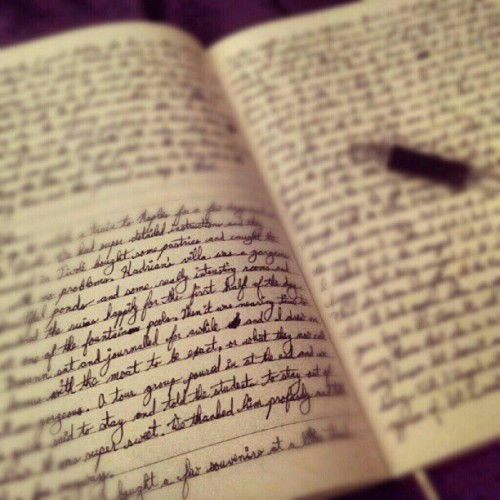
Handwriting in a book
If a picture is worth one thousand words and you aren't using pictures and don't use one thousand words... are you really communicating? Just a thought.

If you are trying to be scientific then yes, brevity is admirable.  You lay out the facts in a logical and clear way that communicates all the important points neatly and concisely.  Well done, you can write a brief report and make charts; but I will argue that this is not what real writing is all about.  Writing is not about merely communicating facts it is about telling stories and communicating feelings.  And stating facts concisely does not make for interesting reading.  Every love story ever told can be condensed into this, two people met each other and fell in love.  That is not interesting.  Yet, we are continually drawn to love stories.  Why is that?  We are drawn to them because we love to watch the way they unfold.  Sure, they all start the same way, with two people who discover that the other person is unlike anyone they've ever met and they can no longer see themselves with anyone else.  But what we really want to know are all the details.  Why it works for them, how they respond to each other and difficult situations, how they work through the struggles that face every couple.  Love brings out the very best and very worst in people and we want to be made to feel for the characters with every delicious word of their story.

Sometimes a sentence just isn't enough to capture the depth of feeling.  Sure you can simply state, I'm angry, or I love you, and leave it at that.  The Emperor of Brevity will no doubt knight you on the spot.  I will argue that this is not enough.  Why you feel that way is just as important as the fact that you do.  The beauty of language is that it allows you to communicate with great variety and depth everything you feel and think.  You have an entire language or two, or three if you're feeling ambitious, to draw words and concepts from to express your thoughts.  You have the ability to use all of the rich and subtle variations of thousands of years of vocabulary to put your feelings into words that express them exactly and beautifully.  Do not cheat them of this richness by believing that brevity is a virtue. 

Scholars may opine that brevity is best.  They may look down in haughty disdain on those of us that cannot reduce our words into scientifically precise sentences.  Yet, I would challenge them to argue that the statement I love you, can in any way compare favorably to an entire love letter.  I would bet they cannot do so convincingly.  No, no, words are a delicious thing and I believe they were meant to be devoured in great quantities.  Let others strive to be concise.  I think I'll keep my words.


Sunday, 8 July 2012

Words, confounding words!

Guaranteed Allergy Quality
Guaranteed allergy quality because substandard allergies are unacceptable  - Photo Credit: Flickr by elliottzone
Allergy friendly.  What does that really mean?  Yes, I know that the phrase is meant to be telling you that you are safe it eat it, use it, or what-have-you.  Somehow this is meant to be alerting you that this product is hypoallergenic.  I mean, hypoallergenic makes sense as a word with the prefix hypo meaning under and having a connotation of less in a medicinal context.  It makes sense then for people with allergies to search for products that have less allergens in them and are therefore hypoallergenic.  But allergy friendly?


I don't know about you, but to me, the expression allergy friendly sounds like it is somehow more friendly with the allergy than the person who suffers from allergies.

I love Pollen
I love Pollen! - Photo Credit: Flickr brookenovak
I can just see a saleswoman telling you "Oh yes, this is a very allergy friendly product.  It practically provides a paradise for allergens to multiply in."
"But," asks the allergy friendly customer, "what about the long lasting benefits?"
"Oh yes, of course.  You see our product is very good for feeding allergies.  It boosts the health of your allergies by providing the right environment and nutrients for allergens to prosper in.  But the allergies will run out of nutrients quickly.  You need to use our product frequently for the best results" says the saleswoman.
"I see. And how quickly can I expect this product to take effect and improve the health of my allergies?" asks the curious customer.
"You can usually see the increased strength in the allergies right away.  Sometimes you can feel your eyes start itching and your breathing become laboured and wheezy within seconds of using our product" says the saleswoman.
"Well, that's rather fast-acting.  That's good" says the customer.
"Oh yes. All our products come with an allergy satisfaction guarantee.  If you are not miserable within minutes your allergies can demand a refund" the saleswoman finishes.
"Perfect, I'll take it" the allergy friendly customer decides.
The saleswoman beams.  It is another glorious day to be an allergy.